Closing the Visibility Gap: How Digital Risk Protection Secures What External Attack Surface Management Can’t See




Table of Contents
EASM vs. DRP
The EASM Blindspot: What You’re Missing
Real-World Examples: Phishing Attacks EASM Didn’t See
Three Ways DRP Completes the EASM Puzzle
Moving from Management to Protection
Today, it’s no longer enough to just understand and protect your digital inventory. Companies also need to understand and protect against brand impersonation, stolen credentials, phishing sites, dark web forums, and more.
External Attack Surface Management (EASM) is only one half of the equation. In this post, we’ll walk through what EASM misses and how Digital Risk Protection (DRP) solutions can help close that visibility gap.
EASM vs. DRP: The Two Halves of External Security
What is EASM?
External Attack Surface Management (EASM) is a cybersecurity process that continuously monitors your public-facing infrastructure to discover, analyze, and monitor potential vulnerabilities in your organization's digital assets, such as domains, IPs, cloud services, and Internet-facing devices.
One of the key benefits of EASM is that it can help companies understand Internet-facing assets that they weren’t even aware existed. For example, Security Magazine reported that organizations found 35% more assets than they were previously aware of from employing EASM tools. These types of shadow IT assets can include any websites, services, and devices that employees use without oversight from the company’s IT department.
EASM solutions show a company what its attack surface, including shadow IT, looks like to a potential attacker. This helps security teams identify and address vulnerabilities before they are exploited. But, EASM only shows companies the digital inventory that they can control. What about assets they don’t own that can be exploited? Or attacks using legitimate credentials that were stolen? That’s where Digital Risk Protection solutions come in.
What is DRP?
Digital Risk Protection (DRP) goes beyond EASM by monitoring a company’s digital footprint and emerging threats from bad actors across the open web, dark web, social media, and spoofed or impersonating assets.
DRP solutions blend threat intelligence, brand monitoring, and fraud detection to go beyond what EASM solutions provide. It helps security teams identify when attackers are actively targeting the organization, not just where vulnerabilities exist.
For example, if a threat actor launches a credential harvesting campaign using a spoofed domain hosted overseas, EASM may never see it because it isn’t part of your infrastructure. By contrast, DRP is designed to detect the phishing domain, alert your team, and initiate takedown efforts before large-scale account compromise can occur.
The EASM Blindspot: What You’re Missing
The biggest difference between EASM and DRP is infrastructure vs. identity. While EASM answers the question of what’s exposed in your infrastructure, DRP answers a more important question: who is abusing your brand, data, or people?
Digital risk protection tools do this by focusing on activity happening in the broader digital ecosystem, including:
Phishing attacks impersonating your login pages
Fake mobile apps published under your brand
Social media accounts impersonating executives or your brand
Leaked employee or customer credentials
Typosquatted domains created for fraud
This is important because the most dangerous attacks today happen on spoofed infrastructure that EASM can't see because you don't "own" it. In fact, phishing attacks are one of the most popular threat vectors deployed by adversaries. An attacker doesn’t need to break into your infrastructure if they can fool your customers or employees into handing over their credentials.
What’s more, the rise of AI-generated brand impersonation makes it even easier for bad actors to impersonate a brand, launch phishing websites, and create convincing deepfakes — areas where traditional EASM solutions have no visibility.
The reality is that EASM is designed to detect exposure within a company’s owned infrastructure. It can give you a list of potential vulnerabilities but that’s where the power of traditional EASM solutions stops.
On the other hand, DRP is designed to detect threats and exploitation, regardless of where they sit. Let’s look at a few examples of where DRP can catch threats that EASM would miss.
Real-World Examples: The Phishing Attacks EASM Didn’t See
Travel Brand Phishing Campaign
Netcraft recently reported about a Russian-speaking threat actor operating an ongoing, mass phishing campaign targeting people planning (or about to leave for) a vacation. Since the beginning of 2025, this bad actor registered more than 4,300 domain names used in the attacks.
The phishing campaign uses a sophisticated phishing kit that customizes the page presented to the site visitor depending on a unique string in the URL path when the target first visits the website. It targets specific individuals (who may have travel reservations) by sending phishing emails containing links that redirect through a service called Want Your Feedback.

Figure 1. An example phishing email message prompting the recipient to confirm a hotel reservation.
The phishing email prompts the user to click a link to visit the hotel's website and confirm a booking using a credit card. However, instead of landing on a legitimate hotel reservation website, the links redirect a visitor's browser through a chain of websites until it lands on the phishing site. The faked site then informs the visitor that they must pay a deposit for their hotel reservation and requests payment card information.
In this real-world scenario, traditional EASM tools would not catch this sophisticated phishing attack because none of these spoofed sites are assets owned by the company. This is where DRP can make the difference. The DRP solution detects the domain registration and SSL certificate issuance in real-time, neutralizing the site before the first email is sent.
darcula Phishing-as-a-Service
darcula is a Chinese-language Phishing-as-a-Service (PhaaS) platform that offers cybercriminals an easy way to deploy phishing sites with hundreds of templates targeting worldwide brands. According to Netcraft’s investigation, darcula phishing attacks typically use purpose-registered domains rather than those that have been compromised, usually spoofing the relevant brand name.
In addition, darcula uses iMessage and RCS rather than SMS to send lure messages to bypass SMS firewalls.
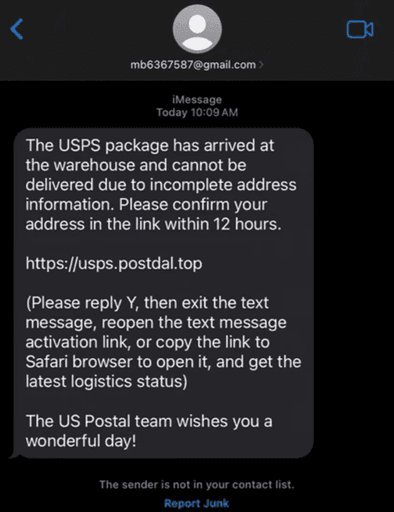
Figure 2. darcula phishing iMessage, image from Reddit /r/phishing
Again, traditional EASM tools wouldn’t be effective against PhaaS platforms like darcula because the spoofed sites and smishing messages aren’t assets owned by the company. However, DRP solutions would help here by detecting the domain registration and SSL certificate issuance in real-time, neutralizing the site before the first email is sent.
3 Ways DRP Completes the EASM Puzzle
Yes, EASM provides critical visibility into your external infrastructure. But, on its own, it’s incomplete. To truly close the visibility gap, organizations need protection that extends beyond owned assets and into attacker behavior, synthetic infrastructure, and identity abuse.
Here’s 3 ways that Digital Risk Protection solutions, like Netcraft, complete the picture.
Instead of simply showing you what attackers could target, DRP shows you what they’re actively exploiting, and even what they’re preparing to exploit. DRP shifts visibility from infrastructure to intent by monitoring these ecosystems.
That early signal and threat intelligence matters. For example, we proactively monitor any threat displaying early warning signs, and swiftly classify, validate and takedown threats as soon as they become live.
Netcraft does this by using a combination of advanced threat intelligence, machine learning, automated scanning, and human verification to detect early signs of phishing activity. We monitor the internet at massive scale — including websites, social media, app stores, and other digital ecosystems.
This is the difference between discovering a vulnerability and identifying an adversary preparing to attack. While EASM looks inward at your servers, DRP looks outward at attacker intent.
Look-alike domains, cloned login pages, counterfeit mobile apps, and spoofed social accounts. None of these are detected by traditional EASM tools.
These types of synthetic assets enable cybercriminals to exploit customers and employees without ever showing up on traditional asset monitoring tools. And, the power of agentic AI makes it easy for these assets to appear, cause damage, and disappear within days, sometimes hours.
DRP identifies these types of brand impersonations across the web, app stores, and social platforms — and initiates takedown processes to neutralize them before large-scale fraud occurs.
As we’ve said before, modern security platforms are about identity, not just infrastructure. Beyond the brand’s name and assets, security teams also need to protect against misuse related to leaked executive credentials, executive brand impersonation, and deepfake assets.
When executive credentials appear on the dark web or deepfake content is used to impersonate leadership, the risk has nothing to do with network integrity. It has everything to do with brand trust and reputation.
DRP brings visibility to that human layer of risk that EASM cannot detect. Unlike EASM tools, DRP platforms can continuously monitor for:
Leaked executive and employee credentials
Deepfake impersonation attempts
Executive and brand impersonation across social platforms
The Complete Picture: Moving from Management to Protection
External Attack Surface Management has enabled security teams to continuously map internet-facing assets, uncover shadow IT, and reduce unintended exposure at scale.
But visibility into infrastructure is only part of the story. You can't manage what you don’t see, and you can't protect what you don't defend.
When you combine EASM with Digital Risk Protection, you move from simply seeing potential risk to actively neutralizing it. This shifts your security team’s focus from management to protection — expanding visibility beyond what’s in your digital inventory to include what’s being weaponized in your brand’s name.
Together, EASM and DRP can transform your operations from reactive exposure management into proactive digital risk defense and close the visibility gap between what you can see and what attackers are doing.
If you’re ready to start defending your identity, brand, and customers, schedule a demo to see how Netcraft’s Digital Risk Protection platform closes the visibility gap for good.
FAQs
What is EASM?
EASM stands for External Attack Surface Management – a cybersecurity process that continuously monitors your public-facing infrastructure to discover, analyze, and monitor potential vulnerabilities in your organization's digital assets, such as domains, IPs, cloud services, and Internet-facing devices.
What is the primary benefit of EASM?
The primary benefit of EASM is that it can help companies understand Internet-facing assets that they weren’t even aware existed, including any websites, services, and devices that employees use without oversight from the company’s IT department. This helps security teams identify and address vulnerabilities before they are exploited.
What is DRP?
In a cybersecurity context, DRP stands for Digital Risk Protection – the practice of monitoring a company’s digital footprint and emerging threats from bad actors across the open web, the dark web, social media, and spoofed or impersonating assets.
What is the difference between EASM and DRP?
The primary difference between EASM and DRP is infrastructure vs. identity. While EASM answers the question of what’s exposed in your infrastructure, DRP answers a more important question: who is abusing your brand, data, or people? Digital risk protection tools do this by focusing on activity happening in the broader digital ecosystem, including brand impersonation websites, fake mobile apps, fake social profiles and leaked employee or customer credentials.
Why should security leaders layer both EASM and DRP into their security strategy?
Integrating EASM and DRP shifts your security posture from risk visibility to active neutralization. This shifts your security team’s focus from management to protection, closing the visibility gap between internal network integrity and the external human layer of risk.