Security leaders are facing a structural mismatch. Attackers operate in minutes. Enterprise response still happens in hours, sometimes days. That gap has become the defining constraint on modern security programs.
For CISOs, security architects, and GRC leaders, the challenge is executing at speed. A modern digital risk management framework must behave less like a reporting system and more like an operational control plane — one that continuously discovers, prioritizes, and eliminates threats across the external attack surface.
In this post, we’ll outline your blueprint for architecting a modern digital risk management framework that creates an active defense strategy for your organization.
The Shift: From Governance to "Live" Exposure Management
Over the past two years, most organizations invested heavily in monitoring. Brand protection dashboards expanded. Threat intelligence feeds multiplied. And inside the SOC, alert volumes have surged — nearly every organization now reports year-over-year increases in alerts.
Yet, outcomes didn’t materially improve. The issue is simple: monitoring without enforcement creates a backlog. And in 2026, backlog is just another word for exposure.
Regulatory pressure is making that exposure measurable. The U.S. Securities and Exchange Commission has increased scrutiny around disclosure timelines, particularly in cases where delays appear avoidable. At the same time, the Digital Operational Resilience Act (DORA) establishes reporting expectations measured in hours for major incidents. Both developments reinforce the same principle: response timelines are now part of the control environment.
Under these conditions, the only metric that matters is the time between detection and neutralization. This is where continuous threat exposure management (CTEM) becomes foundational.
What is CTEM?
A term coined by Gartner in 2022, CTEM (Continuous Threat Exposure Management) is a security framework focused on continuously identifying, prioritizing, and reducing an organization’s exposure to cyber threats. CTEM reframes external threats as a form of technical debt that must be cleared in real time. Every phishing domain left active and every impersonation account still reachable adds to a backlog that can — and eventually will — convert into real impact.
An authoritative framework integrates digital risk protection directly into the automated response layer. Detection is simply the trigger. Remediation is the outcome.
The 4-Layer Architecture of a Digital Risk Management Framework
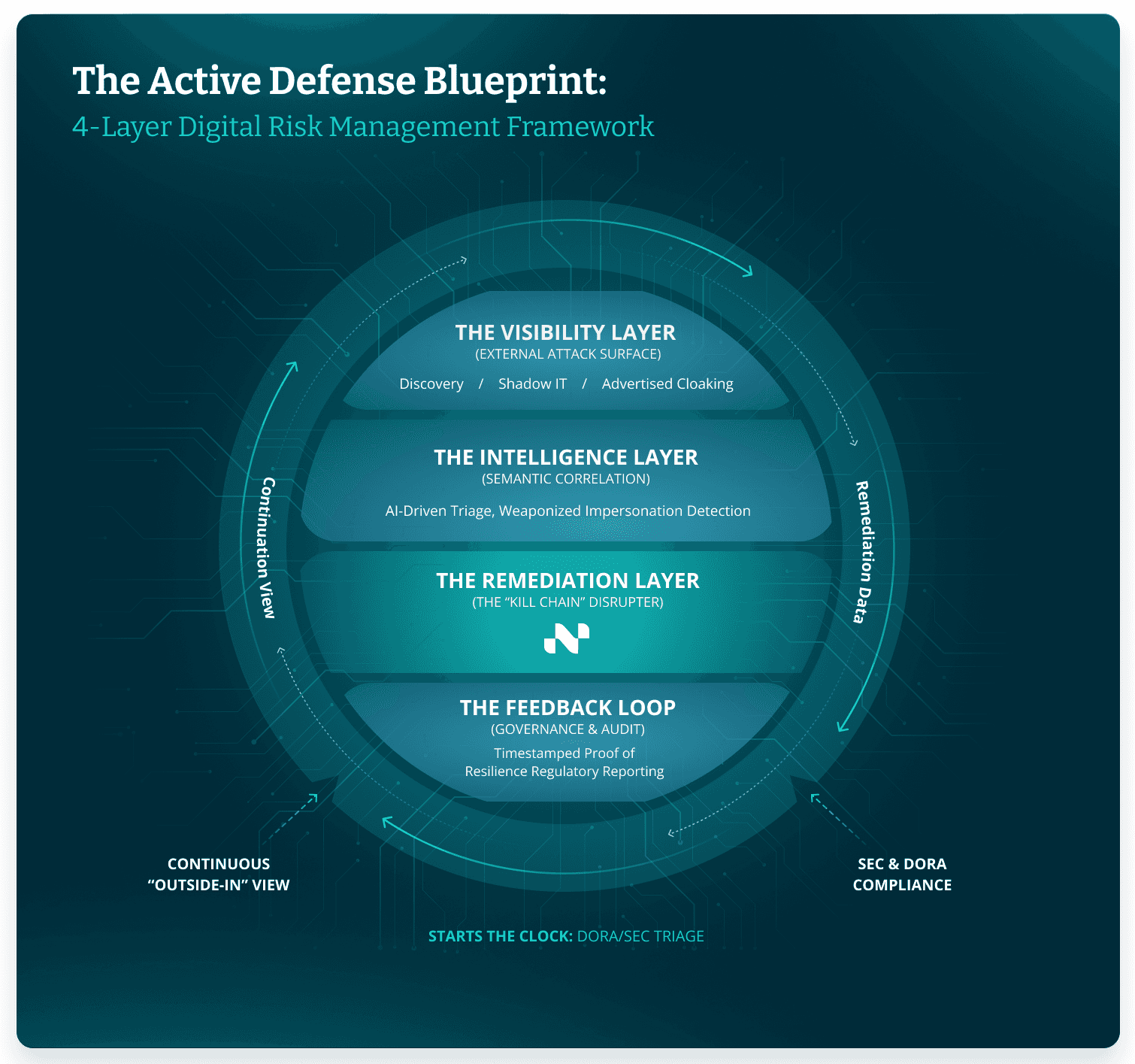
A modern DRP framework takes shape through a set of interconnected capabilities that function as a continuous system. Each layer in this active defense stack contributes to reducing the time between exposure and remediation, creating a loop that is both operational and auditable.
The Visibility Layer: Identifying Your External Attack Surface
The first requirement is comprehensive, continuous visibility — built from the outside-in. This visibility layer establishes the foundation by continuously mapping the external attack surface from an outside-in perspective. Unlike internal asset inventories, which reflect what an organization knows it owns, this layer focuses on what adversaries are actively using or targeting. That includes shadow IT, rogue subdomains, typosquatted domains, and infrastructure designed to mimic legitimate services.
This layer operates in a state of constant discovery. Domains can be registered and weaponized within hours, and malicious content can be selectively presented to evade detection. A static or periodic approach fails to capture that level of dynamism. Instead, visibility must be persistent and adaptive, capable of identifying new threats as they emerge and evolve.
Over time, this layer becomes a real-time map of exposure. It provides the raw signal that feeds the rest of the framework, ensuring that threats are identified early enough for meaningful action to occur.
The Intelligence Layer: Understanding Context with Semantic Correlation
Once threats are identified, the next challenge is interpretation. The intelligence layer evaluates the intent behind what has been discovered, distinguishing between benign activity and malicious behavior at scale. Without this layer, organizations face an overwhelming volume of alerts with little clarity on which ones require immediate action.
AI-driven semantic analysis plays a key role here. It allows the system to understand context — whether a domain is being used for legitimate discussion, passive reference, or active impersonation. This distinction is critical in environments where attackers deliberately mimic legitimate brand behavior to avoid detection.
By prioritizing threats based on intent and likelihood of impact, the intelligence layer enables confident decision-making. It reduces noise, sharpens focus, and ensures that downstream actions are triggered based on meaningful risk rather than raw volume.
The Remediation Layer: Disrupting the Attack "Kill Chain"
The remediation layer operationalizes response. It’s where a digital risk management framework asserts control over the attack lifecycle by interrupting it.
The remediation layer focuses on breaking an attack sequence before it completes, using automation to act at the earliest point of confirmed malicious intent. That requires direct integration with the systems where attacks live — domain registrars, hosting providers, and digital platforms — so that enforcement can happen immediately rather than waiting on manual escalation.
Execution at this layer determines how much exposure an organization carries at any given moment. When remediation is consistent and fast, the attack lifecycle is compressed to the point where downstream impact becomes far less likely. Now, cyber resilience strategies become measurable, expressed through reduced dwell time and fewer successful interactions.
For example, Netcraft partnered with Holvi, a financial institution focused on business banking and account services for self-employed professionals and SME businesses across Europe, to be able to detect and take down phishing with greater speed and coverage. Working with Netcraft, Holvi was able to accelerate takedowns from hours to minutes — cutting off campaigns before they reached meaningful scale.
The Feedback Loop: Supporting Compliance and Operational Improvements
Every action taken within the framework feeds into a continuous feedback loop that supports governance, compliance, and operational improvement. This layer captures detailed records of each event, including detection, validation, and remediation, along with precise timestamps.
This level of documentation transforms operational activity into auditable evidence. For GRC teams, it provides a reliable record of how threats were handled, aligning directly with regulatory expectations and internal reporting requirements. It also reduces the need for retrospective reconstruction of incidents, which can introduce gaps or inconsistencies.
Beyond compliance, the feedback loop strengthens the overall system. By analyzing patterns in detection and response, organizations can refine thresholds, improve automation, and enhance coordination between teams. The result is a framework that evolves continuously, becoming more effective over time.
Eliminating the "Latency Tax" in Risk Procurement
As organizations evaluate solutions to support this model, procurement decisions play a critical role in shaping outcomes.
Many selection processes still fall into the dashboard trap — prioritizing visibility metrics such as dashboard functionality, channel coverage, and detection volume. While these factors provide a sense of scale, they offer limited insight into how effectively a platform reduces active exposure.
A more meaningful measure is Time-to-Takedown (TTT), which reflects how long a confirmed threat remains active before it is neutralized. This metric captures the duration of exposure and directly correlates with the likelihood of impact. When TTT extends beyond a matter of hours, organizations absorb what can be described as a latency tax — the period during which known threats remain accessible.
Traditional brand protection approaches that depend on legal escalation introduce additional delay, particularly in cases involving jurisdictional complexity or manual review. In contrast, the best digital risk protection solutions for enterprise approach remediation as an engineering function, enabling rapid enforcement through direct integrations and automated workflows.
Strategic Implementation: The 30-Day Transition
Shifting to an active digital risk management framework often sounds like a large-scale transformation. But, it’s really more about sequencing than scope. The goal is to move from visibility to enforcement in a controlled way, reducing exposure early while building toward deeper integration.
The first 30 days are about establishing momentum. By focusing on a defined progression — visibility, automation, and integration, organizations can begin reducing exposure windows almost immediately, while laying the groundwork for a fully operational digital risk management framework.
That progression can be mapped as a timeline:
Timeframe | Focus Area | What Changes Operationally | Outcome |
|---|---|---|---|
Days 1–10 | Mapping the True Attack Surface | External discovery expands beyond known assets to include VIP exposure, rogue apps, and API leaks | A realistic, outside-in view of where threats can emerge |
Days 11–20 | Automating Remediation | High-confidence detections trigger enforcement actions, shifting from alerts to takedowns | Reduction in active exposure as threats are neutralized earlier |
Days 21–30 | SOC Integration | External risk signals are fed into SIEM and SOC workflows for correlation and response | Unified visibility connecting external threats to internal activity |
What makes this approach effective is its focus on immediate impact. The first phase surfaces risks that often sit outside traditional inventories. The second phase begins to shrink exposure windows by introducing automated enforcement. By the third phase, external threats are no longer isolated. They become part of the organization’s broader security posture, informing detection and response across environments.
This is also where CTEM starts to take hold as an operating model. Rather than treating external threats as discrete events, the system begins to function as a continuous loop.
The result is measurable progress toward faster response, reduced exposure, and stronger alignment with modern cyber resilience strategies.
Resilience is a Technical Metric
By the end of this transition, something fundamental has changed. Digital risk is no longer managed through periodic review or escalated through disconnected workflows. It is handled continuously, as part of a system designed to reduce exposure in real time.
That shift changes how resilience is defined.
Resilience is often described in terms of policies, preparedness, or governance maturity. Those elements still matter, but they don’t determine outcomes on their own. Instead, resilience shows up in how a system performs under pressure — how quickly it can identify, validate, and neutralize threats across the external attack surface.
Each layer of the active defense stack plays a role:
The visibility layer ensures threats are discovered early.
The intelligence layer establishes which ones matter.
The remediation layer interrupts the attack sequence before it can complete.
The feedback loop captures every action, reinforcing both compliance and continuous improvement.
What connects them all is speed. Each layer contributes to reducing the time between exposure and enforcement.
That performance is measurable. It can be seen in Time-to-Takedown (TTT), in how often threats are neutralized before a user ever encounters them, and in how consistently the system operates across different attack vectors. These reflect how effectively a digital risk management framework functions as an operational control plane, not a legal function.
And, it’s where CTEM becomes real. Instead of accumulating unresolved threats, the system continuously clears them. Exposure windows shrink. The backlog disappears. External risk is handled as it emerges, rather than after it escalates.
In that environment, cyber resilience strategies are now defined by execution. The organization’s ability to withstand and reduce digital threats is directly tied to how fast it can act.
See How Fast Time-to-Takedown Strengthens Active Defense
Read how Netcraft helped one financial services company reduce phishing exposure and operationalize continuous exposure management.
Frequently Asked Questions
What is a digital risk management framework in 2026?
A modern digital risk management framework is an operational control plane that continuously discovers, prioritizes, and eliminates threats across the external attack surface, functioning less like a reporting system and more like an active defense engine.
What are the four layers of an active defense digital risk framework?
The four layers are: the Visibility Layer (mapping the external attack surface), the Intelligence Layer (understanding context through semantic correlation), the Remediation Layer (automated threat neutralization), and the Feedback Loop (supporting compliance and operational improvements).
What is Time-to-Takedown (TTT) and why does it matter?
Time-to-Takedown measures how long a confirmed threat remains active before neutralization. It directly correlates with likelihood of impact and is the most meaningful metric for evaluating how effectively a platform reduces active exposure.
How long does it take to implement an active defense framework?
The transition can be completed in 30 days through a phased approach: Days 1–10 focus on mapping the attack surface, Days 11–20 on automating remediation, and Days 21–30 on integrating with SOC workflows.
Why is automated remediation critical for modern digital risk management?
Automated remediation reduces the gap between detection and neutralization from hours or days to minutes, directly addressing regulatory requirements like DORA and SEC that mandate strict reporting timelines measured in hours
What is the "latency tax" in digital risk management?
The latency tax is the period during which known threats remain accessible because of slow manual processes or legal escalation, creating measurable exposure that increases the likelihood of impact.
How does the intelligence layer reduce alert fatigue?
The intelligence layer uses AI-driven semantic analysis to distinguish between benign activity and malicious behavior, prioritizing threats based on intent and likelihood of impact rather than raw volume.