



Updated 9/23/26
Digital risk protection is no longer a niche function inside cybersecurity. In a recent strategy session with security leaders of a global enterprise, it became clear how easily these risks can go unnoticed; they only discovered a malicious replica of their website by "accident" after being alerted by a partner in Asia that had also been targeted. This highlights a critical reality: as threat actors weaponize brand assets like logos and contact details, enterprises need visibility that extends well beyond their traditional network perimeter.
This guide explains what digital risk protection is, why it matters, how it works in practice, and what security leaders should look for in a digital risk protection service built for speed, accuracy, and measurable business impact.
Table of Contents
Key Benefits of Digital Risk Protection
Digital risk protection is important because external threats can quickly affect customers, employees, and business operations. A strong DRP solution helps reduce exposure early and supports faster, more effective disruption. Key benefits include:
Protects Customers and Employees
Digital threats such as phishing, impersonation, and scam content often target both customers and employees. DRP helps detect and remove these threats before they lead to fraud, compromised credentials, or loss of customer trust.
Reduces Financial, Operational, and Security Impact
External threats can trigger fraud losses, response costs, support burden, and broader security incidents. Early detection and disruption help reduce the downstream impact on business operations and overall cybersecurity.
Supports Brand Protection and Reputation
Fake domains, brand impersonation, and malicious websites can damage a company’s online presence and weaken trust. Digital risk protection supports brand protection by disrupting external threats that exploit brand credibility.
Improves Response Speed and Long-Term Security Posture
Many digital threats operate in short, high-impact windows, so speed is critical. DRP improves threat detection and takedown timelines while also helping organizations strengthen long-term visibility across their digital footprint.
Emerging Threats Only Modern DRP Can Address
The primary threats addressed by digital risk protection services are phishing websites, fake online stores, phone scams, social media impersonation, executive impersonation, fake mobile apps and dark web threats. However, the threat landscape is changing quickly. Over the last 12 months, Netcraft's global threat research team has observed a pivot toward more automated, machine-speed deceptive tactics. The following four examples represent the "new normal" in digital threats, in which modern digital risk protection services must also protect against.
Phishing is now highly commoditized, meaning attacks are no longer limited to financial institutions but target every sector, from government bodies to infrastructure.
We saw this with a "plug-and-play" service that requires virtually no technical skills to operate, using a sleek web panel to automate the setup of phishing infrastructure. This particular service facilitated over $280,000 in criminal transactions in just five months.
We also saw it with a massive campaign that powered more than 17,500 phishing domains targeting over 300 global brands. These operations are increasingly difficult to detect because they use "anti-monitoring" pages, displaying a fake shoe or clothing shop to security crawlers while only showing the malicious content to intended victims who meet specific criteria like a specific geographic location or mobile device type.
In a recent discussion regarding "airline offer" scams on social media, experts noted that attackers now use fake pages to capture one-time passwords (OTPs) in real-time, allowing them to execute fraudulent transactions while the victim is still active.
Threat actors are increasingly using "AI optimization" to trick search engine and AI-generated summaries. By leveraging underground marketplaces, such as the Hacklink market, to buy access to thousands of compromised websites, they inject fake data into various web pages. This allows them to manipulate AI summaries into displaying fraudulent customer support numbers instead of a brand's legitimate contact information.
The rise of autonomous agentic threats allows attackers to weaponize repeated infrastructure patterns to scale operations at machine speed. This trend necessitates continuous monitoring for novel AI-generated indicators such as the "emoji clue" frequently found in suspicious code comments and console outputs.
With agentic AI capable of real-time adaptation and a 60% success rate in fooling human targets, continuous, AI-enhanced monitoring and autonomous takedowns have become a defensive necessity.
A one-time review will not catch emerging threats, and manual checks alone cannot keep up with the volume of potential risks.
How Digital Risk Protection Services Work in Practice
Digital Risk Protection Services (DRPS) provide the technology, threat intelligence, and expertise to deliver protection at scale. These services are considered a core part of modern cybersecurity and brand protection because many attacks now begin across the broader digital footprint, not within the corporate network where traditional cybersecurity solutions have focused.
DRPS follow a structured lifecycle that moves from identifying external threats to validating them and disrupting them quickly. A mature DRP service also feeds results back into security operations through reporting and workflow integration.
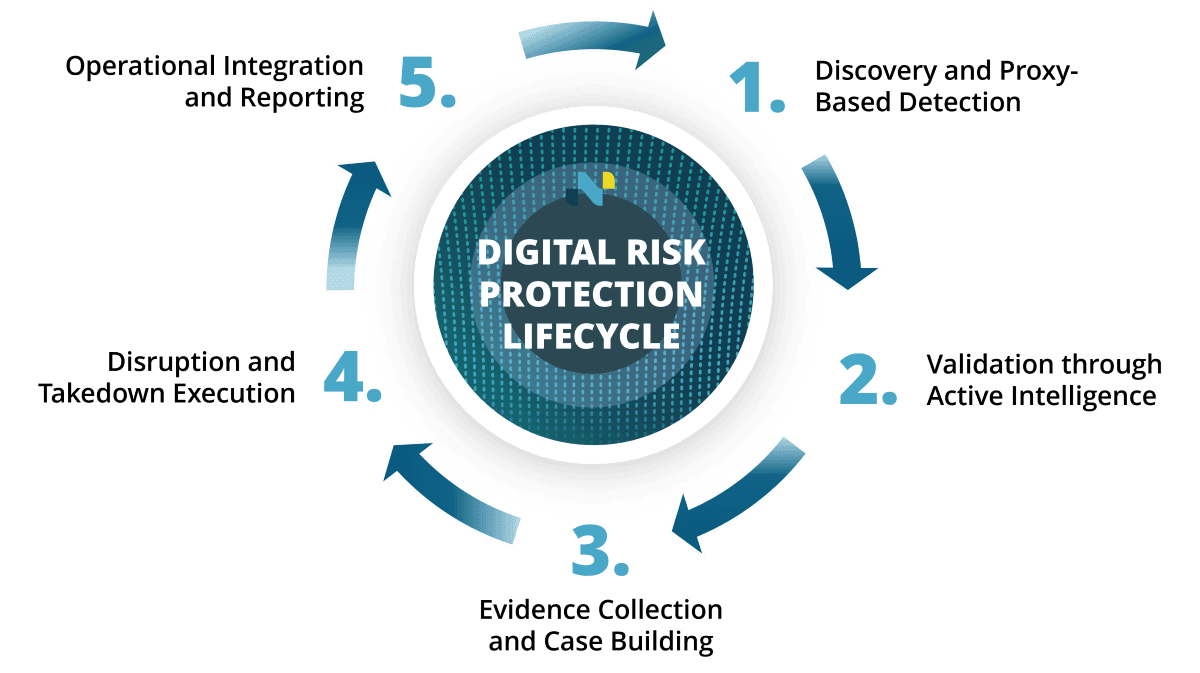
The DRP lifecycle begins with continuous discovery across the organization’s entire digital footprint. Because modern fraudsters now use IP-level and Geo-blocking to hide their malicious content from security providers, effective discovery must go beyond surface-level scanning. To truly "see" what a victim sees, an authoritative DRP platform fetches content through a global network of proxies.
This uncloaked visibility allows the platform to monitor for a wide range of external threats, including malicious domains, social media impersonation, and the third-party infrastructure used for scams. By combining this raw data with automation and machine learning, detection engines can identify suspicious patterns early, surfacing threats before they reach peak impact.
Once a threat is detected, DRP uses active defense tactics to gather intelligence. This step reduces false positives and helps security teams prioritize based on potential impact, brand exposure, and targeting likelihood.
Validation may include checking the content for brand impersonation, analyzing domain and hosting signals, and using scam intelligence (AI bots that communicate with threat actors) to uncover attack mechanics. It also involves determining whether the threat is actively being used to collect sensitive information or support a phishing attack, often through marked account injections to track data exfiltration.
Once a threat is confirmed, teams collect the evidence needed to support enforcement actions. This usually includes screenshots, URL paths, DNS records, domain registration details where available, hosting information, and indicators showing malicious intent.
Strong evidence collection improves disruption success rates and creates internal documentation that supports reporting, governance, and follow-on investigations.
Disruption is the operational goal of the lifecycle. Depending on the threat type, this may include phishing takedowns, domain suspension requests, scam removal, or platform-level actions to remove impersonation accounts.
Speed is the most critical metric because 95% of victims lose money within the first 20 hours of a phishing site going live. Faster takedown timelines reduce victim exposure and help prevent compromised credentials or downstream fraud events.
The final step is integrating outcomes into security operations and long-term risk management. DRP findings should connect to SOC workflows, incident response, and threat intelligence platforms so teams can track actions, measure effectiveness, and strengthen future detection.
Centralized dashboards and reporting help security leaders demonstrate performance, identify repeat targeting trends, and improve the organization’s external threat coverage over time.
Building a Digital Risk Protection Program
A digital risk protection program focuses on external threats targeting digital assets such as domains, IPs, social media accounts, web content, third-party infrastructure, and other public-facing channels. Its goal is to reduce the potential impact of threats before they become a larger cyber attack, fraud event, or security incident.
A comprehensive DRP program typically includes:
Continuous threat discovery across domains, IPs, social platforms, and third-party infrastructure.
Threat intelligence and risk assessment to validate potential cyber threats.
Disruption actions such as phishing takedowns, domain suspension, and scam removal.
Reporting that supports risk management, security operations, and long-term protection.
Measuring the Success of a Digital Risk Protection Program
To measure DRP performance, organizations need clear metrics tied to both security outcomes and business impact. The most useful KPIs show how quickly threats are found, how long they remain active, and whether consistent disruption is reducing attacker success over time.
Key metrics often include:
Time to detection — how quickly an external threat is identified
Time to takedown — how long it takes to disrupt or remove a confirmed threat
Victim exposure — how long users remain exposed before disruption begins
Attack volume — how many external threats are detected over time
Repeat targeting rate — how often the same brand or assets are targeted again
Disruption success rate — the percentage of validated threats successfully removed or suspended
These metrics support long-term security strategy because they show whether DRP is only reacting to incidents or actively reducing future risk. Consistent disruption can deter potential threat actors by increasing the cost and lowering the effectiveness of attacks.
Just as importantly, clear reporting helps security leaders build a business case for stronger external coverage and more mature digital risk protection.
What to Look for in a Digital Risk Protection Solution
Security teams evaluating a DRP solution should begin with core capability questions: How broad is the detection coverage? How accurate is the validation process? How quickly can threats be disrupted? Those factors determine whether the solution can deliver sustained protection or only partial visibility.
Related reading: 5 Questions to Ask Your Next Digital Risk Protection Vendor
Detection coverage should extend across domains, social media, scam infrastructure, malicious websites, and broader digital assets. A narrow tool may miss important external threats or only cover one digital channel. Accuracy also matters. If the system generates too many false positives, teams lose time and confidence.
Takedown speed and disruption effectiveness are equally important. Manual DRP approaches may support small volumes, but they become difficult to maintain as attack volume rises. Semi-automated workflows improve efficiency, but fully automated systems are better suited for enterprise-scale protection where fast response is essential.
A strong solution should help security teams:
Detect more external threats across the full digital footprint
Reduce false positives through context and validation
Disrupt malicious activity quickly across global infrastructure
Scale without relying on large manual review teams
Deliver reporting that supports ROI and sustained cyber risk reduction
In practice, automation is what turns DRP into an operationally viable long-term program.
For a curated list of providers, see The 7 Best Digital Risk Protection Providers in 2026.
How Netcraft Approaches Digital Risk Protection
Netcraft approaches digital risk protection as a continuous process of detection, disruption, and takedown. Its methodology combines automation, AI and machine learning, and broad cyber threat intelligence coverage to identify malicious activity across phishing, fraud, scams, and other digital threats. The DRP platform can process more than 23 billion datapoints annually and classify more than 100 attack types, giving enterprise teams wide visibility across the external threat landscape.
That outcome is tied to the design of Netcraft’s Brand Protection platform and broader digital risk protection service. Netcraft combines AI-driven automation with human expertise, which allows teams to move quickly while maintaining accuracy and reliable enforcement.
For enterprises, that means more than fast takedowns. It means reduced attack frequency over time, stronger brand resilience, and a more mature approach to managing digital risk across multiple brands, channels, and geographies.
Conclusion
Digital risk protection is a foundational capability for modern enterprises because so many attacks now begin across the external digital footprint.
The most effective DRP strategies must be built on speed, visibility, and proactive disruption. Relying on manual checks or domestic-only monitoring creates gaps that sophisticated actors, using AI optimization and real-time phishing, will eventually exploit.
Security leaders should assess whether their current strategy provides enough external threat coverage, enough disruption speed, and enough operational visibility to reduce real-world risk.
For organizations that need scalable, high-impact digital risk protection, Netcraft can help detect cybersecurity threats early, act quickly, and support stronger long-term protection.
Frequently Asked Questions
What is digital risk protection?
Digital risk protection (DRP) is the cybersecurity practice of identifying and disrupting digital threats that exist outside an organization’s internal environment. Its goal is to protect brands from external online threats such as brand impersonation, phishing websites and social media scams.
What are digital risk protection services?
DRPS combine technology and managed services, integrating threat intelligence, automated response and human expertise, to deliver digital risk protection at scale.
Why is digital risk protection important for enterprises?
Digital risk protection is important because external threats can quickly lead to fraud, compromised credentials, operational disruption, and reputational damage. A strong DRP program helps reduce exposure early and improves an organization’s ability to respond before threats escalate.
How does digital risk protection differ from traditional cybersecurity?
Traditional cybersecurity focuses on protecting assets within the corporate network perimeter, while DRP targets external threats that exploit brand trust, public infrastructure, and customer-facing channels outside the organization's internal environment.
What types of threats do digital risk protection solutions address?
DRP solutions address phishing attacks, fake domains, typosquatting, malicious websites, social media impersonation, scam campaigns, fraud infrastructure, and AI-driven agentic threats that exploit brand credibility and target customers or employees.
How does digital risk protection work?
Digital risk protection follows a structured lifecycle: continuous discovery and detection across the digital footprint, validation and risk assessment to confirm threats, evidence collection for enforcement, disruption and takedown execution, and operational integration with security workflows and reporting.
What should security teams look for in a digital risk protection solution?
Security teams should look for broad detection coverage, accurate threat validation, fast disruption capabilities, and automation that can support high attack volumes. Clear reporting is also important because it helps teams measure performance and show long-term risk reduction.
How is digital risk protection success measured?
Success is measured through metrics including time to detection, time to takedown, victim exposure duration, attack volume trends, repeat targeting rates, and disruption success rates that show whether the program is reducing future risk.