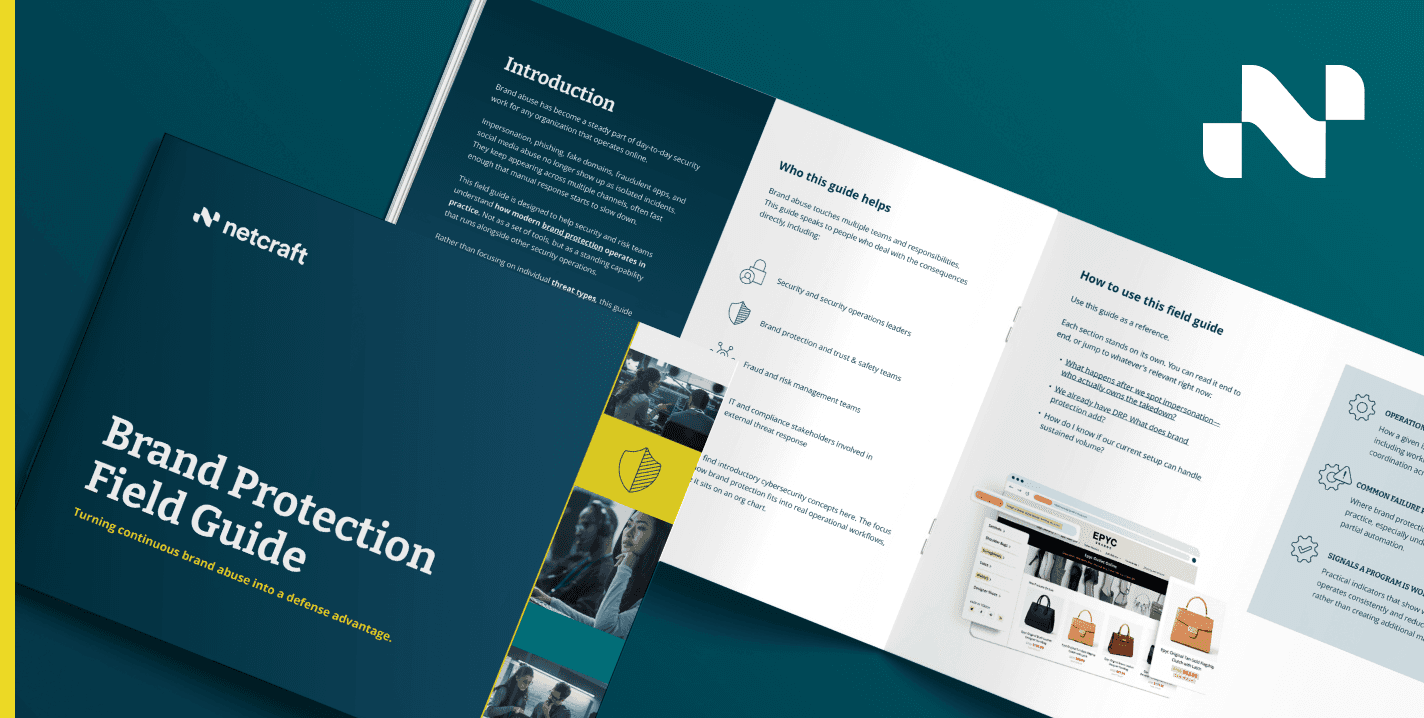
Introduction
Brand abuse has become a steady part of day-to-day security work for any organization that operates online.
Impersonation, phishing, fake domains, fraudulent apps, and social media abuse no longer show up as isolated incidents. They keep appearing across multiple channels, often fast enough that manual response starts to slow down.
This field guide is designed to help security and risk teams understand how modern brand protection operates in practice. Not as a set of tools, but as a standing capability that runs alongside other security operations.
Rather than focusing on individual threat types, this guide looks at:
How brand abuse manifests at scale
Why traditional brand protection approaches struggle to keep up
What an effective, repeatable brand protection
program looks like inside an organization
Throughout, the emphasis stays on operations: how the work runs, how outcomes get measured, and how teams maintain consistency over time.
Who this guide helps
Brand abuse touches multiple teams and responsibilities. This guide speaks to people who deal with the consequences directly, including:
Security and security operations leaders
Brand protection and trust & safety teams
Fraud and risk management teams
IT and compliance stakeholders involved in external threat response
You won’t find introductory cybersecurity concepts here. The focus stays on how brand protection fits into real operational workflows, not where it sits on an org chart.
How to use this field guide
Use this guide as a reference.
Each section stands on its own. You can read it end to end, or jump to whatever's relevant right now:
What happens after we spot impersonation—who actually owns the takedown?
How do I know if our current setup can handle sustained volume?
Where it helps, sections call out:
Operational reality: How a given issue or decision affects day-to-day work, including workload, response speed, ownership, and coordination across teams.
Common failure points : Where brand protection efforts tend to break down in practice, especially under volume, time pressure, or partial automation.
Signals a program is working as intended: Practical indicators that show whether brand protection operates consistently and reduces downstream impact, rather than creating additional manual effort.
1. Why brand protection evolved as abuse scaled
SECTION TAKEAWAY
Brand abuse didn’t just increase in frequency; it changed how the work behaves. As organizations strengthened internal defenses, customer engagement expanded across external platforms, and brand abuse scaled alongside it. What once appeared as isolated incidents became continuous operational load.

Brand exposure expanded across external channels
Most customer interaction now happens outside internal systems. Domains, social platforms, apps, marketplaces, ads, and third-party services are where brands build recognition and trust.
They’re also where attackers operate, often using brand assets to create:
Lookalike and spoofed domains
Phishing and fraudulent websites
Impersonation accounts on social platforms
Fake or modified mobile apps
Abuse within ads, marketplaces, and forums
By impersonating a brand in those spaces, attackers don’t need to breach anything internally. They rely on familiarity instead— logos, names, tone, intellectual property, and timing. The damage happens before security teams ever see a signal.
What makes this harder is not just the location, but the fragmentation. Each platform has its own reporting mechanisms, enforcement standards, and response timelines. Coordinating removal across them requires process, persistence, and scale.
As brand presence expanded across channels, abuse scaled with it. The work stopped behaving like occasional investigation and started behaving like sustained operational volume.
Attackers reuse infrastructure and scale horizontally
Modern brand abuse rarely depends on new techniques. Attackers reuse the same infrastructure, automate setup, and make small variations across channels.
A single phishing site becomes several lookalikes
One executive impersonation account turns into a cluster
A takedown in one place pushes activity somewhere else
What changes isn’t the method. It’s how many versions of the same problem appear at the same time.
Each instance still needs validation, prioritization, and action. While no single case feels harder on its own, the work no longer ends. The same patterns keep resurfacing across domains, platforms, and campaigns.
Work shifts from sequential to parallel
As abuse scales, response stops arriving as a queue teams can work through at their own pace.
Multiple cases appear at once, across different channels, often sharing the same underlying infrastructure. Teams move from handling one issue at a time to managing many in parallel.
That shift introduces friction:
Validation takes longer
Decisions get deferred
Ownership becomes less clear
Even small delays matter, because attackers continue reusing infrastructure while response is still in progress. Over time, teams spend more effort to reach outcomes that previously required far less coordination.
OPERATIONAL REALITY
When abuse appears in real time across channels, teams face a trade-off between speed and consistency. Without automation, manual review and one-off response slow down quickly, and work spreads across teams before anything gets taken down.
Manual response collapses under volume
Many organizations still treat brand abuse as a queue: something comes in, gets handled, and disappears. That model fails once abuse becomes continuous.
Blocking may reduce exposure temporarily, but it rarely ends the problem. Unless the underlying infrastructure is removed, activity reappears through other channels—often slightly changed, and usually sooner than expected.
At this stage, brand abuse stops being a visibility problem and becomes an operational one. Its impact goes beyond security metrics:
Customer trust is affected first. Most people don’t distinguish between a strong brand and a convincing impersonation. Confusion spreads quickly, support queues grow, and trust becomes harder to recover than the original incident.
Response becomes reactive. Escalations increase, timelines stretch, and teams spend more time coordinating than resolving abuse.
Normal work gets disrupted. Even when no single brand infringement incident looks severe, ongoing abuse interrupts day-to-day work across security, support, and communications.
The issue isn’t finding abuse faster but sustaining response without turning every case into an escalation. This is the point where modern brand protection emerged: not as a new category, but as a response to how the work behaves once abuse becomes continuous in a sprawling attack surface.
Common failure points
Abuse is detected early but stays live longer than expected
Brand protection response time stretches as volume increases
Similar cases reappear across channels
Coordination effort grows faster than impact reduction
2. What modern brand protection means in practice
SECTION TAKEAWAY
Modern brand protection means carrying abuse through from threat detection to takedown. It does so consistently, at scale, and without restarting the process every time the same patterns reappear.
Online brand protection becomes “modern” when teams approach it as an end-to-end operational problem.
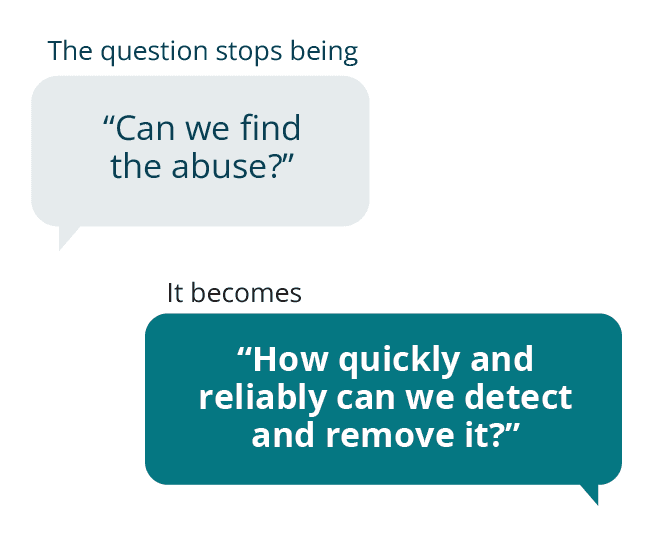
That reliability comes from running detection, disruption, takedown, and monitoring as one continuous workflow.
DetectSurface active abuse and high-risk infrastructure early | DisruptLimit harm while response is underway | TakedownRemove abuse at the source | MonitorStop the same work from coming back |
|---|---|---|---|
Continuously scans domains, social platforms, apps, marketplaces, and ads to detect fraud, impersonation, and high-risk look-alike registrations, including pre-emptive domains. Monitors suspicious infrastructure, with activation or malicious use triggering prioritized response and coordinated action. | Automatically reduces access to malicious content across browsers, devices, and geographies while takedown is in progress. Buys time and limits exposure during high-volume phishing or scam campaigns. | Removes malicious content by working directly with the parties that control the infrastructure, including registrars, hosting providers, platforms, and upstream services. Evidence is gathered and routed automatically, with progress tracked end to end. | Monitors removed abuse and high-risk domains to detect resurgence or reuse of the same infrastructure. If content returns, the takedown process restarts automatically, reducing repeat work and stabilizing response over time. |
Each stage on its own solves part of the problem and running them together is what changes the operational outcome.
No amount of dashboards or threat intelligence alone increases a team’s capacity the way a connected workflow does. Brand protection software automation absorbs volume, evidence accelerates action, and continuity prevents the same work from coming back.
Rather than reacting to individual incidents, teams build a system that resolves abuse by default. Progress is visible, ownership stays clear, and repeat abuse declines over time instead of compounding.
And instead of adding more threat intel reports to a CISO’s plate, they take action to protect brand integrity and the people who rely on it.
3. How brand protection fits into the external risk flow
SECTION TAKEAWAY
External risk shows up in stages. Digital risk protection makes external threats visible and actionable across channels. Brand protection is the function within that program that takes responsibility for removing identity-based abuse.
Understanding how brand protection fits means following how abuse work enters the organization, how ownership is assigned, and where abuse is either removed or allowed to persist.
Step 1: External risk becomes visible
Before turning into a confirmed incident, most external digital risk appears as signals. These can come from monitoring platforms, threat intelligence feeds, domain registrars, social platforms, or customer reports.
At this stage, the organization knows something exists, but not yet what should happen next.
This is where digital risk protection plays its role. DRP aggregates and contextualizes signals across many risk types, helping teams understand what is happening outside the perimeter, which issues deserve attention, and what action is needed to disrupt the threats before harm escalates.
Step 2: Visibility alone does not assign ownership
Once signals surface, someone needs to act. For identity-related risks, DRP makes it clear what needs to be dealt with and who needs to act, so brand abuse doesn’t linger while teams figure out next steps.
That visibility is where every digital risk protection program begins, but it’s not where value is created. That comes from what it enables next.
Step 3: Brand protection takes responsibility for brand abuse removal
Within a digital risk protection solution, brand protection focuses specifically on threats that exploit a company’s identity. It becomes distinct at the point where removal of these threats matters.
Rather than stopping at advanced detection or prioritization, brand protection owns the workflow end to end within its scope:

Ownership does not shift between teams at each stage. That continuity is what allows response to remain consistent under pressure.
Within the external risk flow, brand protection answers a specific operational question: not whether external threats exist or need action, but how identity-based abuse is removed as part of the wider DRP program.
OPERATIONAL REALITY
When brand abuse stays in a visibility layer, teams often know about it early but still rely on ad hoc coordination to act. As parallel cases accumulate, response slows.
Step 4: Domain protection reduces exposure, not impersonation
Domain protection often intersects with this workflow, but only at specific points.
Practical question | Domain protection | Brand protection |
|---|---|---|
What are you protecting? | Owned domains | Brand identity |
Who owns the asset? | The organization | Often a third party |
How do you stop the abuse? | Securing the domain | Takedown of the asset |
For instance, if a customer reports phishing attacks or sites using your logo on a third-party domain, domain protection can't help—you don't own that domain. Brand protection steps in to request takedown from the hosting provider and preserve the company’s reputation.
This is why domain protection functions as an input, not an outcome. It supports digital risk protection but does not resolve identity-based abuse on its own.
Step 5: Intelligence accelerates action, but does not replace it
Threat intelligence supports every stage of the workflow. It provides context about attacker behavior, vulnerabilities, infrastructure reuse, and emerging patterns.
What intelligence does not do on its own is close the loop.
Point in the workflow | Intelligence provides | Brand protection adds |
|---|---|---|
Detection | Awareness | Actionability |
Analysis | Context | Prioritization |
Response | Insight | Takedown |
Outcome | Understanding | Removal |
Without a function that owns follow-through, intelligence increases awareness but leaves the response burden unchanged. Brand protection is one of the execution capabilities of DRP that keeps it moving, turning intelligence into repeatable removal, not just earlier knowledge.
Signals a program is working as intended
Alerts carry actionable context into existing workflows
Analysts spend less time switching tools and more time managing outcomes
Operational effort drops as response becomes more streamlined
4. How a modern brand protection program operates
SECTION TAKEAWAY
A working brand protection program absorbs volume automatically, resolves abuse consistently, and operates without constant escalation or manual coordination.
Modern brand protection runs continuously because the risk does. Abuse does not wait for review cycles, and effective programs are built to operate alongside other security functions without pulling teams into daily firefighting.
The capabilities below are what allow that consistency under pressure.
Continuous monitoring without manual oversight
Brand abuse doesn’t follow business hours, and it doesn’t limit itself to one part of the internet.
Effective programs rely on autonomous, 24/7 monitoring across the surface web, social platforms, app stores, marketplaces, and deep and dark web sources.
Using brand protection software for monitoring surfaces abuse early and in context, allowing teams to act before it spreads.
A shared operational view of each attack
Detection alone is not enough. Teams need a central view of what is happening and where response stands:
What the abuse is
Where it is live
How exposure is being reduced
Where it sits in the takedown process
This operational visibility removes follow-ups and handoffs. Teams can see progress without chasing updates across tools or inboxes.
Validation that balances automation with judgment
At scale, not every case can go to human review, but not every signal should be trusted blindly.
Automated classification validates known attack patterns quickly using rules, pattern matching, and machine learning. Headless browsers and global fetch locations safely interact with suspicious content, even when attackers attempt to hide behavior.
Human expertise is reserved for edge cases, detection refinement, and quality control, keeping response fast without allowing false positives to accumulate.
Prioritization that reflects real risk
Not all abuse carries the same impact, and not all of it needs immediate action.
Effective programs automatically prioritize threats based on risk indicators: domain characteristics like typosquatting or homographs, infrastructure signals, registrar reputation, certificate issuance patterns, and where the abuse appears across channels.
When prioritization works, high-risk abuse moves first, and lower-impact issues don’t clog the response pipeline.
Investigative tooling built for takedown
Investigation exists to support removal, not curiosity.
Purpose-built tooling captures evidence—screenshots, behavior, and technical details—safely and automatically. That evidence flows directly into takedown requests, reducing back-and-forth with infrastructure providers and speeding up action.
Takedown as a built-in capability
This is where many programs quietly fail.
Takedown requires scale, relationships, and repeatable process. Takedown requests must reach the right registrars, hosting providers, platforms, or upstream services through the channels they respond to, with the evidence they require for mitigation to take place.
When takedown is built into the program, removal of the threat happens in hours rather than days—consistently rather than occasionally.
Integration that reduces workload
Brand protection doesn’t operate in isolation.
Programs that hold up over time integrate with existing security tooling—SIEMs, APIs, threat intelligence platforms, and SOC workflows—so response data flows where teams already work.
Signals a program is working as intended
Alerts carry actionable context into existing workflows
Analysts spend less time switching tools and more time managing outcomes
Operational effort drops as response becomes more streamlined
Operational reporting and accountability
Operational reporting keeps brand protection aligned with outcomes.
Effective programs track a small set of metrics that reflect how well takedown and follow-through work in practice:
Time from detection to takedown
Volume of abuse handled over time
Repeat use of attacker infrastructure
Workload trends as volume fluctuates
This brand protection reporting flow clarifies ownership and highlights where process improvements are needed. Instead of reviewing alert counts or isolated incidents, teams review whether abuse is removed, how quickly, and with how much manual effort.
That shift turns reporting into proactive measures and control mechanisms that allow teams to adjust workflows and automation before problems escalate.
5. Where brand protection breaks down in practice
SECTION TAKEAWAY
When brand protection starts to feel slow or repetitive, it’s usually not because threats changed. It’s because response assumptions that worked at lower volume no longer hold.
For many organizations, there’s a clear moment when brand protection starts to feel heavier: the same abuse patterns keep returning, response takes longer, and more people get involved to reach the same outcome.
The patterns below capture the assumptions that tend to appear at that point.
Assumption | What teams expect | What happens in practice |
|---|---|---|
Blocking is enough | Limits immediate exposure | Abuse remains active and reappears elsewhere |
Alerts indicate progress | More visibility means more control | Alert queues grow without reducing risk |
Speed solves the problem | Fast response limits impact | Manual speed collapses under volume |
Detection equals protection | Knowing is half the battle | Knowing without takedown increases workload |
One team can handle it | Brand protection feels contained | Fallout spreads across security, fraud, support, and PR |
If any of these patterns feel familiar, the issue is usually that brand protection response has outgrown the model it’s running on. The next step isn’t more alerts, faster scans, or more people chasing incidents. It’s deciding where responsibility for removal sits, and whether your current model can carry that responsibility consistently.
6. From reactive response to stable brand protection
SECTION TAKEAWAY
Stable brand protection takes shape when brand abuse stops reshaping the organization’s priorities. Response becomes routine, disruption declines, and planned work stays intact.
Once brand abuse becomes routine, response has to work like any other standing security function.
Stability in a brand protection strategy shows up in small, practical ways:
Previously handled abuse patterns trigger response automatically
Takedown progress is visible without manual follow-ups
Fewer handoffs are required to resolve incidents
Escalations become the exception, not the norm
Monitoring catches reuse early, before the same infrastructure turns into another fire drill. Workload levels out instead of spreading across teams.
Abuse still occurs. It simply no longer dictates how the organization works.
How to tell whether your brand protection program is stable
Most organizations don’t reach stability after a single major brand image or trademark infringement incident. They arrive here when everyday response starts to feel heavier than it should.
Use the checklist below to assess whether your current approach is reducing repeat work—or quietly recreating it.
You don’t need to hit every point for the program to be effective. What matters is the overall direction:
Is repeat work declining?
Is response becoming more consistent?
Is coordination getting easier instead of harder?
If the answers trend yes, the program is stabilizing.
If most effort still goes into rediscovering, revalidating, or re-escalating the same abuse, the loop hasn’t closed yet.
Checklist
Do you have good brand protection in place?
1. Does the program cover the full range of places where brand abuse appears?
☐ Trademark and copyright: misuse of brand names, logos, and protected assets across online channels
☐ Domains: lookalike domains, typosquatting, hijacking, and malicious registrations
☐ Phishing and impersonation (including AI-assisted abuse): sites, messages, and campaigns designed to deceive customers or employees
☐ Social media and fake accounts: impersonation profiles, fraudulent ads, and coordinated social abuse
☐ Website impersonation and fake shops: clone sites that mimic legitimate brands to steal data or payments
☐ Ads and paid placements: fraudulent or misleading ads abusing brand identity
☐ Online scams: brand-linked scams operating across messaging platforms and forums
☐ Mobile apps: fake or modified apps distributed through official or third-party stores
☐ Deep and dark web: brand abuse, trade, or coordination taking place outside the public web
2. Does the program stop at visibility or carry cases through to removal?
☐ Takedowns are part of the default workflow, not an escalation
☐ Detection, disruption, takedown, and monitoring are connected
☐ Repeat abuse triggers response automatically
3. Can it absorb volume without adding manual effort?
☐ Detection and validation are automated by default
☐ Blocking and disruption trigger without manual coordination
☐ Takedown requests are generated and routed automatically
☐ Human effort is reserved for edge cases, not routine
4. Does brand protection reduce drag across teams?
☐ SOC involvement decreases over time, not increases
☐ Fewer ad hoc escalations to fraud, support, legal, or comms
☐ Workload stabilizes even when abuse volume rises
5. Does the program keep working without constant attention?
☐ Protection runs continuously, not in review cycles
☐ Takedowns happen in hours, not days
☐ Reuse of attacker infrastructure declines over time
☐ Outcomes are tracked through confirmation of removal
When brand protection becomes a business conversation
When brand protection becomes stable, its effects extend beyond security operations. Reduced disruption shows up across the organization.
Where it shows up | What teams experience | Why it matters |
|---|---|---|
Marketing | Campaigns no longer stall after impersonation incidents | Momentum is preserved instead of rebuilt |
PR and communications | Planned messaging replaces reactive reassurance | Strategy and brand reputation stay intact |
Customer-facing teams | Fewer reassurance and safety questions | Customer confusion and harm decline |
Security and fraud | Less revalidation and repeat response work | Operational load stabilizes |
Cross-team coordination | Fewer ad-hoc escalations and alignment meetings | Time and attention stay focused |
Each of these issues can feel manageable in isolation. Together, they determine whether brand abuse stays contained or spreads work across the organization and supply chain.
Making the case for stable brand protection
By the time brand protection buy-in becomes a leadership conversation, teams have usually been dealing with the work for months. For brand owners, abuse no longer affects just security teams. It shows up in e-commerce, customer support, and brand management—often long before an incident is formally recognized.
The issue is no longer isolated incidents, but a pattern these leaders recognize and understand:
Recurring disruption
Repeated effort
Declining return on time spent responding
A stable brand protection program changes that experience. Fewer issues escalate, fewer teams are pulled in, and response becomes predictable rather than interrupt-driven.
A simple executive framing could be:
“Right now, the same brand abuse issues keep pulling people off planned work. Stable brand protection either makes that work predictable or removes it altogether.”
Conclusion
Keeping trust intact and the problem calm
Brand abuse isn’t going away. The practical goal is to make it a manageable part of your operations and defense strategy, so it doesn’t keep competing with everything else on the roadmap.
Use this guide to pressure-test your current approach: where work stalls, where ownership breaks, and where repeat issues keep reopening. Once you can see those pressure points clearly, you can decide which parts of the work belong inside your team, and which parts should stop consuming time altogether.
Ready to see how this works in practice?
→ See how Netcraft's platform works
→ Talk to us about your current brand protection setup
Netcraft has been removing brand abuse at internet scale for over 20 years. Our platform handles detection, disruption, takedown, and monitoring as one continuous workflow—so your team manages outcomes instead of logistics.
Key Takeaways
Why did brand protection evolve as abuse scaled?
Brand abuse didn’t just increase in frequency—it changed how the work behaves. As organizations strengthened internal defenses and expanded across external platforms, brand abuse became a continuous operational load rather than isolated incidents.
What does modern brand protection mean in practice?
Modern brand protection means carrying abuse through from threat detection to takedown—consistently, at scale, and without restarting the process every time the same patterns reappear.
What is the four-stage workflow in brand protection?
The four-stage workflow is:
Detect
Disrupt
Takedown
Monitor
Running these stages as one continuous workflow is what changes the operational outcome.
How does brand protection fit into the external risk flow?
External risk becomes visible through signals, but visibility alone does not assign ownership. Brand protection is the function that takes responsibility for removing identity-based abuse within the broader digital risk protection program.
What is the difference between domain protection and brand protection?
Domain protection secures assets the organization owns, while brand protection focuses on removing abuse from third-party infrastructure where the organization does not have control.
Why does manual response collapse under volume?
Many organizations treat brand abuse as a queue, but that model fails once abuse becomes continuous. As volume increases, response becomes reactive, coordination effort grows, and similar cases reappear across channels.
How does a modern brand protection program operate?
A modern program runs continuously, with:
Continuous monitoring without manual oversight
A shared operational view of each attack
Validation that balances automation with judgment
Prioritization that reflects real risk
Takedown as a built-in capability
Where does brand protection break down in practice?
Brand protection breaks down when assumptions no longer hold at scale—for example, when teams believe blocking is enough, detection equals protection, or one team can handle the workload. In practice, abuse remains active and reappears elsewhere.
What does stable brand protection look like?
Stable brand protection is when response becomes routine:
Previously handled abuse triggers response automatically
Takedown progress is visible
Fewer handoffs are required
Escalations become the exception, not the norm
How do you know whether your brand protection program is stabilizing?
If repeat work is declining, response is becoming more consistent, and coordination is getting easier instead of harder, the program is stabilizing.
What is the goal of brand protection?
The goal is to make brand abuse a manageable part of operations so it doesn’t keep competing with everything else on the roadmap.